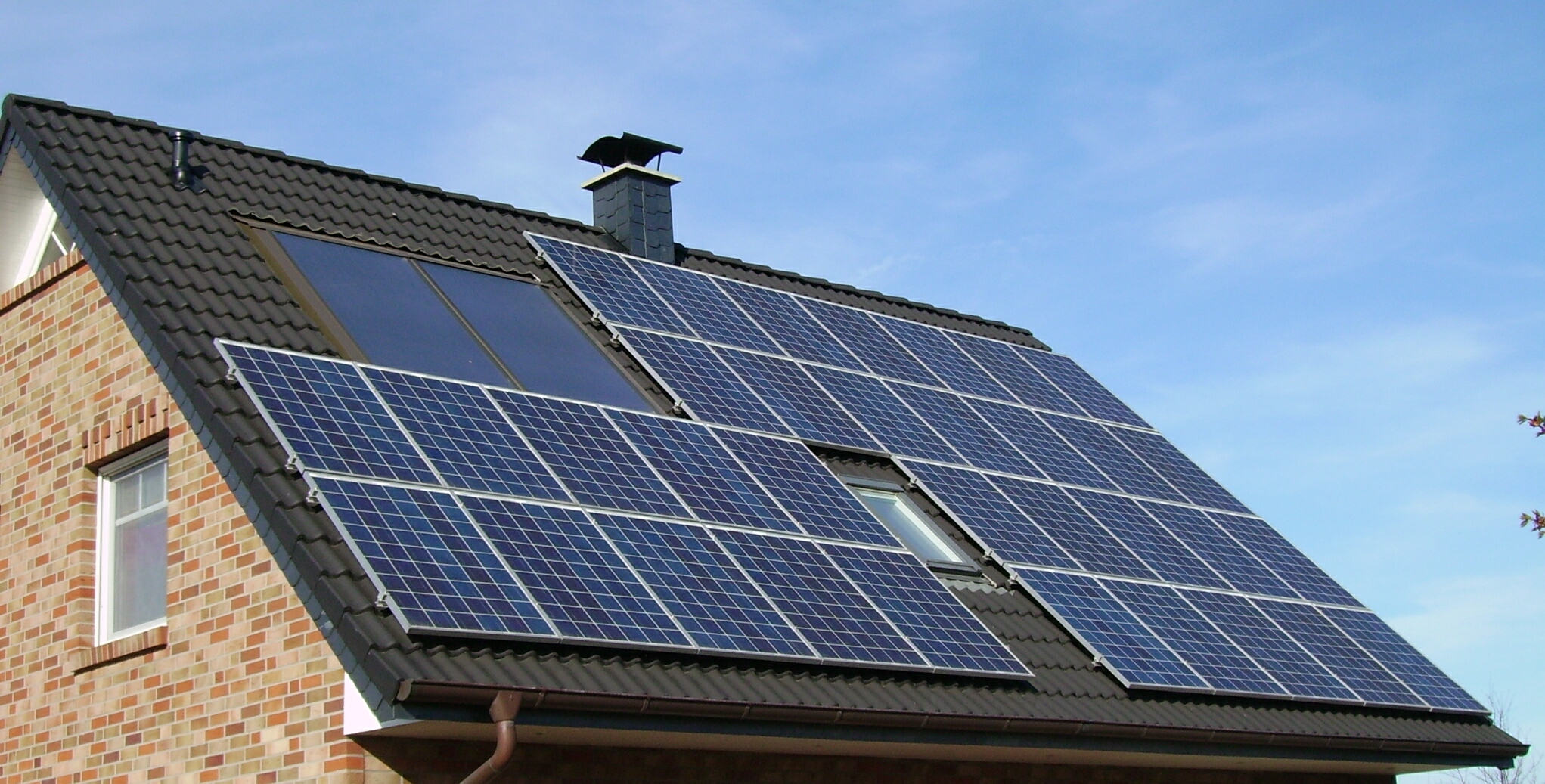
Choosing a photovoltaic panel for a residential property in the Czech Republic involves balancing efficiency, available roof area, budget, and how well a given technology performs in Central European weather patterns. Three main technologies dominate the residential market: monocrystalline silicon, polycrystalline silicon, and thin-film. Each has distinct production characteristics that translate directly into real-world performance differences.
Monocrystalline Silicon Panels
Monocrystalline panels are cut from a single continuous silicon crystal grown using the Czochralski process. The resulting cells have a uniform dark appearance and a higher electron mobility than polycrystalline variants.
Efficiency range
Standard residential monocrystalline modules currently achieve 19–22% efficiency under Standard Test Conditions (STC: 1000 W/m², 25 °C, AM 1.5 spectrum). Premium PERC (Passivated Emitter and Rear Cell) and TOPCon variants reach 22–24%. For a typical 30 m² usable south-facing roof section, a 22% panel delivers roughly 6.6 kWp, which covers the annual electricity consumption of an average Czech household (approximately 3 500–4 500 kWh/year) with some surplus for storage or grid export.
Temperature coefficient
The power temperature coefficient of monocrystalline cells is typically around –0.35 to –0.40% per °C above 25 °C. During Czech summer peaks, roof-mounted panels can reach 60–70 °C, reducing output by 12–18% compared to STC. This is not unique to monocrystalline technology but is worth factoring into annual yield estimates.
Durability and warranty
Most tier-1 monocrystalline manufacturers offer a 25-year linear power warranty guaranteeing at least 80–87% of rated output at end of life, and a 10–15 year product warranty covering materials and workmanship. The panels themselves typically last 30–35 years before degradation becomes economically significant.

Polycrystalline Silicon Panels
Polycrystalline panels are produced by melting silicon fragments together and casting the resulting ingot into blocks. The process is less energy-intensive than growing a single crystal, which historically made polycrystalline modules cheaper. The multiple crystal grains visible under the surface create the characteristic blue metallic sheen.
Efficiency range
Efficiency for polycrystalline residential panels typically falls between 15 and 18%. The gap with monocrystalline technology has narrowed over the past decade, but remains significant enough that polycrystalline panels require roughly 20–25% more roof area to generate the same annual yield. On a constrained roof this matters considerably.
Cost considerations
By mid-2025, the wholesale price difference between polycrystalline and standard monocrystalline modules had narrowed to roughly 5–10% per watt-peak, making the cost argument for polycrystalline less compelling than it was in 2015–2018. Most Czech installers now default to monocrystalline or PERC unless a client specifically requests otherwise.
Thin-Film Panels
Thin-film technology deposits semiconductor material in very thin layers — typically cadmium telluride (CdTe), amorphous silicon (a-Si), or copper indium gallium selenide (CIGS) — onto glass or flexible substrates. The result is a lighter panel that performs better in diffuse light conditions.
Performance in overcast conditions
This property is relevant for Czech residential installations. The Czech Republic averages 1 500–1 700 peak sun hours per year, with the summer months concentrated in June–August. During the October–February low-sun period, thin-film panels maintain a slightly higher relative output compared to crystalline panels, though absolute generation is limited regardless of technology.
Limitations for residential use
Thin-film panels have lower efficiency (10–14% for commercial CdTe; 13–17% for CIGS), meaning more roof area is required. They are also less widely available through Czech distributors and carry fewer installer certification programmes. Residential thin-film installations represent a small fraction of the market — the technology is more common in large ground-mounted and commercial flat-roof systems.
Side-by-Side Reference
The following figures represent typical residential-grade panels available in the Czech market as of early 2026, under STC:
- Monocrystalline (standard): 19–22% efficiency, –0.35%/°C, 25-year power warranty, ~0.20–0.28 EUR/Wp installed
- Monocrystalline PERC / TOPCon: 21–24% efficiency, –0.30%/°C, 25-year power warranty, ~0.25–0.34 EUR/Wp installed
- Polycrystalline: 15–18% efficiency, –0.40%/°C, 25-year power warranty, ~0.18–0.24 EUR/Wp installed
- Thin-film CdTe/CIGS: 12–17% efficiency, –0.25 to –0.32%/°C, 25-year power warranty, limited residential availability in CZ
Installed costs quoted above are indicative only and vary with system size, roof complexity, inverter choice, and whether battery storage is included. Obtain multiple quotes from certified Czech installers before making a decision.
Making the Selection in a Czech Context
For a standard Czech detached house (rodinný dům) with 25–40 m² of south- or south-west-facing roof at 30–45° pitch, monocrystalline PERC or TOPCon modules currently represent the most space-efficient option. If the roof is large and budget is the primary constraint, standard polycrystalline panels remain a viable choice. Thin-film is rarely the right fit for a residential pitched roof installation given its space requirements and limited local support infrastructure.
The inverter pairing — string inverter, microinverter, or power optimiser — interacts with panel type and shading conditions and should be evaluated alongside the panel selection. See also our related article on energy storage options for context on how panel capacity affects battery sizing.
For regulatory requirements covering the installation itself, refer to our regulations overview.